

16 Sep Beyond Trees (Part 3): The Reality of Forest Harvesting in Ireland
The Reality of Forest Harvesting in Ireland
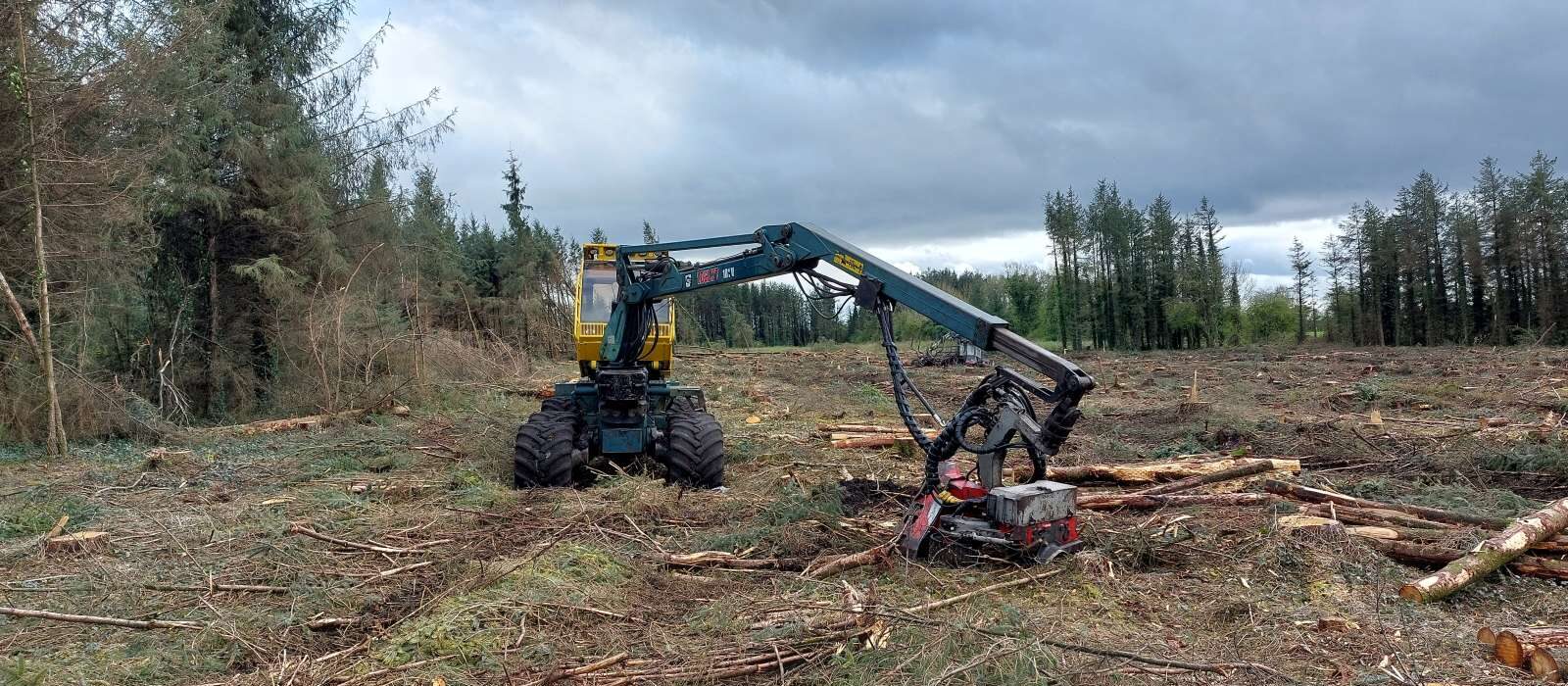
Most people think of forest harvesting as the easy part of forestry.
The trees have finished growing, the machinery arrives, the timber is loaded and driven away. Compared with planting or managing a forest, harvesting appears straightforward.
The reality is very different.
Forestry Doesn’t Run Like Most Businesses
Most of us are used to businesses working in a fairly predictable way. If you hire a builder, plumber or electrician, you expect a quotation, a start date, regular working hours, updates if they’re delayed and some idea of when the work will be finished.
Forest harvesting rarely works like that.
Harvesting contractors operate in an environment where weather, machine breakdowns, timber markets, haulage, sawmill demand and ground conditions can change overnight. A contractor who expected to spend three weeks on your forest may disappear after two days because another site has suddenly become workable, or because persistent rain has made your site inaccessible.
That can be frustrating for forest owners. They naturally expect the forester to control the contractor. In reality, that control is often far more limited than people imagine.
Successful harvesting is not about following a rigid timetable. It is about constantly adapting to changing conditions while keeping the operation moving safely, efficiently and in compliance with the conditions of the licence.
In reality, harvesting is where twenty or thirty years of forestry decisions finally become visible.
When Something Goes Wrong
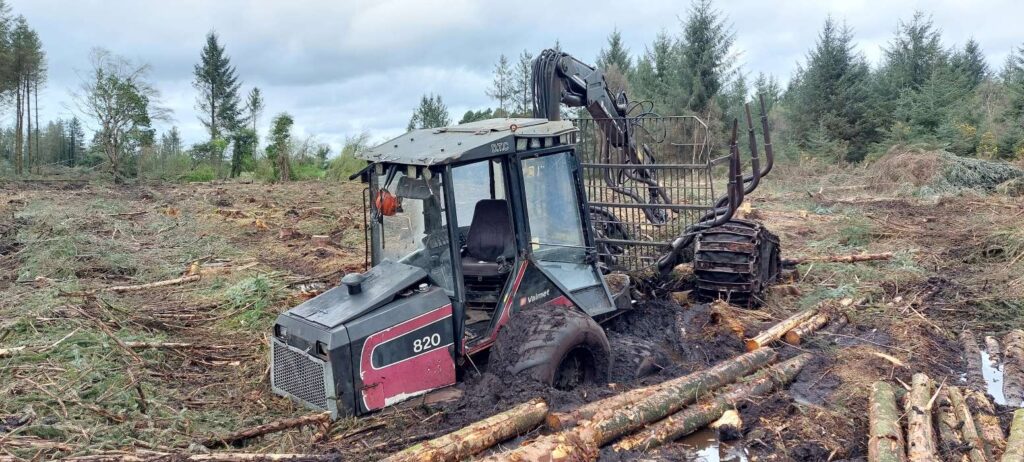
Every harvesting operation encounters problems. A machine may leave ruts after unexpected rain. A culvert may become blocked. Mud may end up on a public road. A stack of timber may inconvenience a neighbour. None of these situations are unusual, and most can be resolved through cooperation.
What has changed over the past twenty-five years is often not the problem itself, but the response to it.
Forestry now operates under intense public scrutiny. Images can appear on social media within minutes, often without any context. Public discussion tends to focus on environmental damage rather than the practical realities of harvesting, placing pressure on everyone involved.
Instead of asking, “How do we put this right?”, the first reaction can become, “Who is going to be blamed?”
The forest owner worries about their reputation. The harvesting contractor worries about future work. The forester worries about professional responsibility. Time and energy that could have been spent solving the problem is instead spent deciding where responsibility begins and ends.
Problems are inevitable in any practical operation carried out with heavy machinery in changing weather conditions. Good management is not about pretending problems never occur. It is about recognising them early, dealing with them quickly and preventing them from becoming something much more serious.
Paperwork, Planning and Timing
For many forest owners, the biggest surprise is discovering that harvesting cannot simply begin when the crop is ready.
Although the forest may be ready for harvesting, obtaining permission to begin is often only the start of the process. Depending on the site, applications may involve referrals relating to ecology, archaeology, water protection and other environmental considerations. Where a harvesting road is required, that often involves a separate approval process.
The result is that obtaining permission to carry out a simple first thinning can take months or, in some cases, years.
Only once approval has been granted can meaningful discussions begin with harvesting contractors. Until then, nobody knows exactly when work can start.
By the time the licence finally arrives, contractors are usually committed elsewhere. The harvest simply joins the queue.
Even then, timing remains critical. Many forests cannot be harvested at any time of year. Ground conditions, weather, environmental requirements and the risk of windblow all influence when operations should take place. Every owner wants harvesting carried out in ideal conditions—but so does every other owner.
This means harvesting contractors are a limited resource. Larger or more accessible sites may naturally take priority, leaving smaller forests waiting longer for the right opportunity.
I often read forestry reports that conclude a plantation suffered financial loss because thinning was delayed. While that may be true, the report rarely explains why the thinning was delayed in the first place.
Form Matters More Than Volume
One of the biggest misconceptions about forest harvesting is that more timber automatically means more money.
Volume is important, but it is not a guarantee of value.
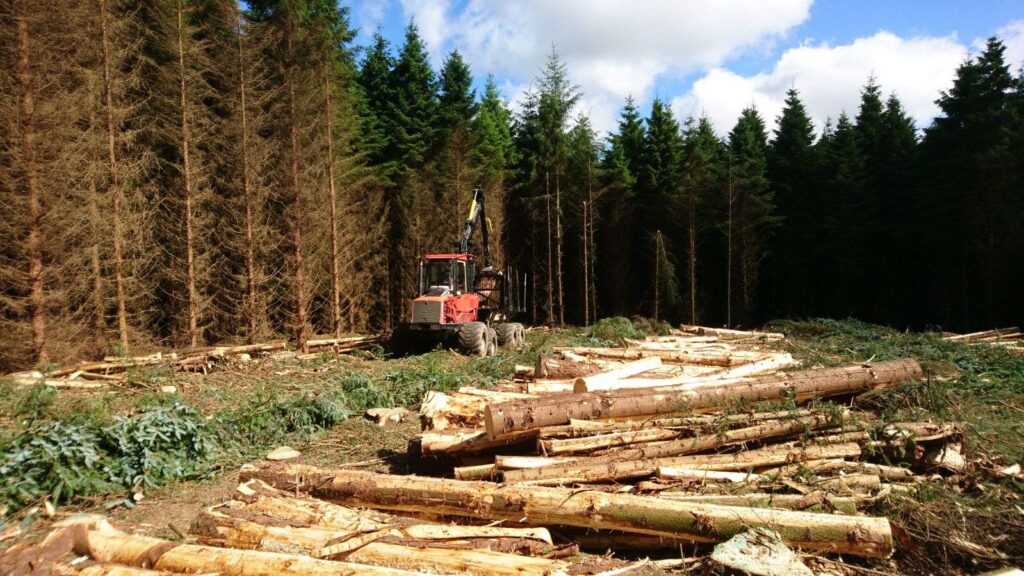
Equally important is form—how straight, clean and well-developed each stem is. Straight stems produce high-value sawlog. Poorly formed trees, regardless of their size, often end up as pulpwood, woodchip or low-value firewood.
In my experience, poor form is rarely an accident. It is usually the legacy of poor management many years earlier. Removing the best stems for short-term financial gain often leaves the poorest-quality trees to form the final crop.
By the time harvesting begins, those decisions cannot be undone.
Form is also difficult to measure accurately while the trees are still standing, which is why estimated values and final harvest returns can differ considerably. Two trees of exactly the same volume may have completely different values once processed.
What Determines Timber Value
One of the biggest surprises for many forest owners is discovering that the price quoted by a sawmill is rarely the amount they actually receive. The value of a harvest depends on far more than the headline timber price.
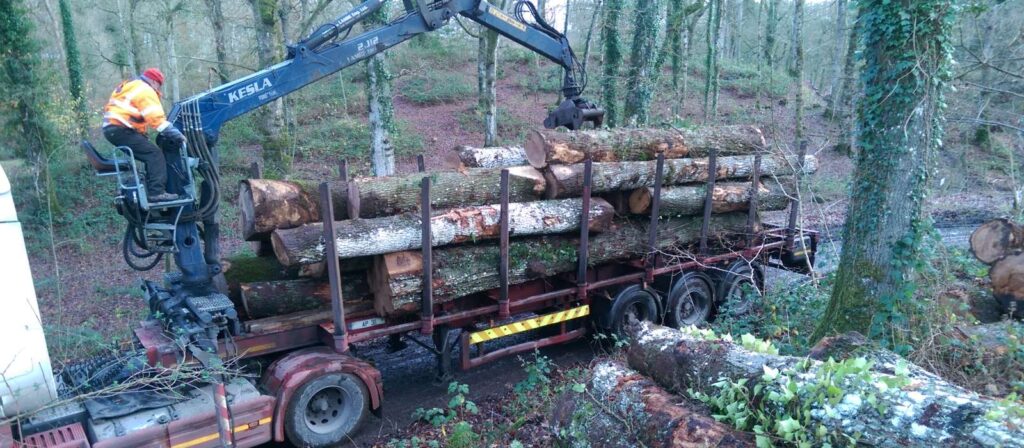
Timber can be sold standing, roadside or delivered to the mill. The difference between these methods is largely the point at which harvesting, extraction and haulage costs are deducted. Consequently, the price quoted by a sawmill is rarely the amount the forest owner ultimately receives.
The quality of the timber is the first major factor. As discussed earlier, trees with good form produce higher-value sawlog, while poorer-quality stems may only produce pulpwood or woodchip.
The forest itself also plays a significant role. A well-designed plantation with good extraction routes is quicker and cheaper to harvest than one with long forwarding distances, awkward boundaries or difficult terrain.
Access can have an equally important impact. Forests with good internal roads, loading bays and turning areas can be harvested far more efficiently than sites where timber must be extracted over long distances or loaded from narrow entrances. Even where an owner has invested in an excellent forest road, the public road leading to the site may still limit the size of timber lorries, increasing transport costs.
Finally, haulage distance has a major influence on value. A forest located close to a sawmill has a clear advantage over one situated many kilometres away. Higher fuel costs, longer journey times and fewer realistic buyers all reduce the value ultimately returned to the owner.
When all these factors are combined, two forests producing similar volumes of timber can deliver very different financial returns.
Understanding this helps explain why experienced foresters look far beyond the headline timber price when assessing the value of a harvest.
The Forester’s Real Role
On paper, a forester’s role during harvesting appears straightforward. They prepare maps, estimate volumes, mark trees, obtain licences and monitor the operation.
In reality, that is only a small part of the job.
One of the forester’s most important roles begins before harvesting starts: giving the forest owner clear and realistic expectations about the likely outcome. That means explaining not only what the timber may be worth, but the likely costs, the quality and range of timber products that may be produced, how the operation is likely to progress and what the forest may look like afterwards. Estimates are important, but forestry involves too many variables for every outcome to be predicted precisely. In my experience, owners cope far better with an unexpected result when they understand from the beginning what could realistically happen.
I have managed several forest harvests annually since 1998. Over that time, I have also been contacted by many forest owners after harvests managed by others because they were disappointed with the outcome. They may be unhappy with the financial return, the condition of the site, the amount or quality of timber produced, or simply unsure whether the harvest was managed as well as it could have been. Unfortunately, by that stage much of what matters has already happened. The trees have been cut, the timber has left the forest and many of the decisions that determined the outcome cannot be reversed. It is one of the reasons I believe experienced forestry advice is most valuable before and during a harvest, rather than afterwards.
To many owners, their forest is unique. It may represent decades of investment, their retirement fund or something they hope to leave to the next generation. To a harvesting contractor, however, it is simply another job in a busy schedule. One of a forester’s most important roles is bridging those two perfectly understandable viewpoints.
A harvest rarely goes exactly to plan, and much of a forester’s work involves managing the people involved rather than the trees themselves. Contractors have practical and commercial pressures. Forest owners have understandable expectations about what should happen and when. The forester sits between them, trying to keep the operation moving while ensuring that environmental conditions, safety requirements and licence conditions are all being met.
Much of a forester’s time is spent answering questions rather than marking trees or recording the harvest data.
Why haven’t the machines arrived today?
Why did they leave early?
When will the next timber payment be made?
Which mill received the last load?
Where are the weight dockets?
These are perfectly reasonable questions, and owners expect their forester to have the answers.
Bridging those two perspectives is one of the most important parts of a forester’s role.
Good supervision is about far more than recording volumes. It means recognising when something doesn’t look right. Is more pulp coming out than expected? Are valuable logs being downgraded unnecessarily? Are timber lorries leaving fully loaded and consistently? Is the operation progressing as efficiently as it should?
No owner could reasonably pay a forester to stand beside a harvesting machine every minute of every day. Effective supervision depends on experience—knowing what needs to be checked, when it needs to be checked, and recognising problems before they become expensive mistakes.
Good harvesting supervision isn’t about seeing everything that happens.
It’s about knowing enough to recognise when something isn’t happening as it should.
When Reality Takes Over
No harvest ever goes exactly to plan.
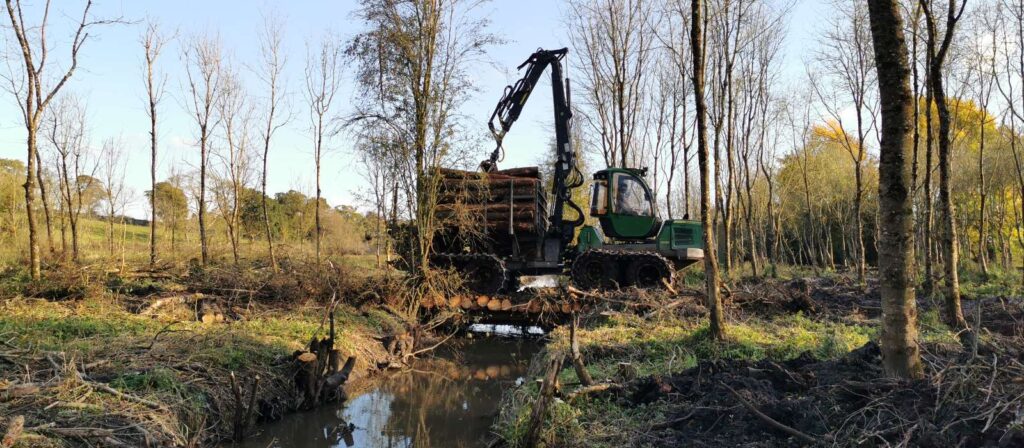
Harvesting is a practical operation carried out in a natural environment, and things do go wrong. Machinery breaks down, tracks come off, hydraulic pipes burst and unexpected ground conditions emerge. I’ve even been involved in harvests where machines became so badly bogged down that recovering them took weeks.
Sometimes the weather becomes the biggest challenge. I remember one harvest on what should have been a straightforward site. An exceptionally wet summer turned the entire operation into a quagmire. Access became difficult, forwarding slowed dramatically, far more brash was needed to protect the ground, and water management became a constant concern. Every aspect of the operation became more complicated.
On another site, the access road itself collapsed under the weight of loaded timber lorries. On others, timber quality proved very different from what had been expected, or haulage arrangements had to change as circumstances evolved.
None of these situations were planned, and none were caused by poor management. They were simply the realities of working in forests.
The important point is not that problems occur—it is how they are managed.
A forester cannot simply report problems back to the owner and walk away. Their job is to find practical solutions, minimise delays, protect the site and keep the operation moving safely. That often means making decisions quickly, adapting to changing circumstances and balancing the needs of the owner, the contractor and the environment at the same time.
Good harvesting is not the absence of problems. It is the ability to manage them before they become major ones.
Expectations and Reality
Many forest owners understandably expect harvesting to provide a significant financial return, particularly when carrying out a first thinning. In reality, a thinning should often be viewed as an investment in the future crop rather than an opportunity to maximise immediate income.
A well-executed thinning improves the quality and value of the remaining trees. Chasing the highest possible return from an early thinning by removing the best stems can reduce the value of the final crop for decades to come.
The same gap between expectations and reality often appears in forest management itself.
When a harvest runs smoothly, owners sometimes question what their forester actually did. From their perspective, the contractor arrived, the timber was harvested and the money was paid. Good management can appear almost invisible.
The picture changes completely when something goes wrong.
Suddenly the questions become far more detailed. Why wasn’t this anticipated? What steps were taken to prevent it? Why wasn’t the contractor instructed differently? What records exist? What evidence was kept?
Having acted as an expert in several forestry disputes, I’ve found that experienced foresters acting for different parties often reach remarkably similar conclusions about what happened on site. Unfortunately, by the time independent opinions are sought, legal positions have usually hardened, substantial costs have already been incurred, and the focus has shifted from solving the problem to winning the dispute.
Good contracts, clear communication and realistic expectations remain the best protection for everyone involved.
Conclusion
From a distance, harvesting appears to be the simplest stage of forestry. In reality, it is often the most demanding.
Every harvest is shaped by decades of previous decisions, influenced by weather, markets, legislation, ground conditions and the countless practical challenges of working in a living landscape.
The forester’s job is not simply to oversee the cutting of trees. It is to anticipate problems, adapt when conditions change and ensure that the harvest is completed safely, responsibly and to the highest possible standard.
Like so much in forestry, good management is often invisible. When everything goes well, it can appear that very little happened. In reality, that is usually the clearest sign that an experienced forester was quietly preventing small problems from becoming big ones.
(Read Part 1: The Real Work of a Forester in Ireland or Part 2: The Reality of Tree Planting in Irish Forestry
If you are interested in harvesting, thinning, or need guidance in this area, get in touch with Ecoplan.