

An independent forestry expert with full-spectrum experience across Ireland’s forest sector — from commercial conifer management to native woodland systems — who advises landowners based on their objectives, not a fixed model.
Ecoplan Forestry was established in 2007 by Sean McGinnis, a qualified forester with over 28 years’ experience across all aspects of forest management in Ireland.
Sean’s career began with conservation work in Africa, followed by a role as an assistant Forester and Wildlife Manager in Scotland, before returning to Ireland where he progressed through senior roles to become Operations Manager with one of Ireland’s leading forest investment companies, with responsibility for forestry operations nationwide.
Ecoplan’s work spans the full range of Irish forestry — from commercial conifer plantations to native woodland and amenity forests. Management is not based on a fixed model or ideology, but on the specific objectives of each client, the characteristics of the site, and sound professional judgement developed through decades of practical experience.
How Ecoplan Works
Ecoplan was established to provide an alternative to the standard, one-size-fits-all approach that characterised much of Irish forestry at the time. When the company was founded, very few forestry providers were offering alternative approaches such as native woodland management or Continuous Cover Forestry, and most forest management followed a standard cycle of planting, thinning, and clearfelling.
Ecoplan takes a different approach. Each forest is managed based on the objectives of the owner, the characteristics of the site, and what is realistically achievable over the long term. In some cases, that may involve commercial conifer management and clearfelling. In others, it may involve Continuous Cover Forestry, native woodland conservation and restoration, or a combination of approaches.
There is no single “Ecoplan system”. The role of the forester is to assess the options available and to advise the client on the most appropriate course of action — not to apply a fixed model regardless of circumstances.
This approach reflects the reality of forestry in Ireland: some sites are suited to intensive timber production, others to long-term ecological management, and many require a balance of both. Ecoplan’s role is to navigate that complexity and to deliver the best possible outcome for the landowner.
Experience That Matters
Ecoplan’s work is built on long-term relationships and consistent results.
Many clients have worked with Sean since the late 1990s and chose to continue that relationship with him through subsequent roles and into Ecoplan following its establishment in 2007. In some cases, forests that were planted and established under his management are now reaching maturity and being harvested, providing a full-cycle perspective from establishment through to final harvest.
A corporate forestry company may have decades of history, while the forester assigned to an owner’s land changes every few years. Each new forester has to learn the forest, its past decisions and the owner’s objectives. Ecoplan offers something different: Stewardship Continuity with the same forester, and knowledge of both the land and the person who owns it built over many years. Stewardship Continuity can be promised, but few forestry businesses in Ireland can demonstrate it.
The company works with a relatively small number of clients, allowing each forest to be managed individually rather than as part of a large portfolio. This reflects a deliberate approach: forestry is not treated as a volume-based business, but as a long-term investment requiring careful planning, attention to detail, and continuity of management.
A running chronological record of our historical field operations and project logs can be viewed on our Updates & Archive page.
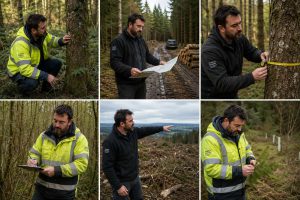
Professional forester and independent forestry consultancy services in Ireland – Ecoplan Forestry
Current Work
Sean’s work continues to span a wide range of forestry activity — from lecturing degree students at the Technological University of the Shannon, to involvement in complex forestry and land management issues, including complex and high-level disputes. This breadth of work reflects both his experience across the sector and an ongoing interest in the practical and regulatory challenges of forestry in Ireland.
At its core, Ecoplan reflects a long-standing commitment to forestry and an approach developed over many years working across a wide range of forests and situations.
Sean McGinnis is a member of the Association of Irish Forestry Consultants and the Society of Irish Foresters. These organisations support professional standards, continuing professional development, and the advancement of forestry in Ireland.
The Same Principles Since Day One
Ecoplan Forestry was established in 2007. While forestry policy, grant schemes, and environmental priorities have evolved considerably since then, our core philosophy has remained remarkably consistent. From the beginning, we have promoted practical forestry that balances environmental, economic, and social values. The archived 2009 website shown below highlights themes that remain central to our work today, including native afforestation, native woodland conservation, woodland improvement, and sustainable estate management. We believe forests should be managed not only as productive assets, but also as long-term investments in biodiversity, landscape, heritage, and future generations; and we have always believed that.

The Ecoplan Forestry website in 2009. The principles that guide our work today—including native afforestation, native woodland conservation, and close-to-nature forest management—were already central to our approach in 2009.
Further information on Ecoplan’s work, including specific projects, services, and articles on forestry practice, can be found throughout the site, or just feel free to get in touch if you would like to discuss your own forest.
(This website is managed and updated by Ecoplan Forestry. All of the content on this website, including the articles, photographs and opinions expressed, was created by Sean McGinnis unless otherwise stated.)

Ecoplan European Bee Award 2022
EU Business Award 2021
Agriculture and Farming Awards 2021

Irish Enterprise Award 2020

RDS Award Ecoplan Forestry