

16 Mar Forest Operations in Silvergrove, Co. Cork
This page sets out the documented sequence of events and decisions relating to the Silvergrove site, based on Forest Service records, the FAC decision, and High Court proceedings. (Updated March 2026)
Written in January 2019:
In response to the enormous amount of interest regarding the recent forestry operations in Silvergrove, Kilbarry, Co. Cork, (loosely referred to as Toon Wood) I’m delighted to take this opportunity to answer some of the genuine concerns raised, and to give some background and explanation of what we are trying to achieve there.
Background
The land owner at Silvergrove is a woman with a keen interest in both history and the environment. She approached Ecoplan Forestry in 2014 wondering if she could somehow combine her poor agricultural land and scrub woodland into the ancient, traditional land management practice of ‘wood pasture’, the mutually beneficial integration of trees, forages and livestock.
‘Wood Pasture’ or Silvopasture is an enlightened land management technique. It is currently being promoted by the Forest Service as Agro-forestry due to it’s enormous benefits, and is grant-aided at the establishment stage. Please see the sites: Silvopasture and agroforestry. I was extremely interested in the project. It was a tradition in the area, and it would have a range of benefits both economic and environmental.
The Application Process
My initial site visit showed a farm that had fallen into disrepair over the years. Neither farmland nor woodland; furze, bracken and willow were encroaching onto the open fields throughout. The existing trees were predominantly clusters of coppiced ash, birch and willow, with individual oak and holly in places. The tree stocking was varied, but generally extremely low, and thicker on the boundaries. Ash was regenerating naturally, along with pockets of the other species in places. I estimated the 13Ha was 50% open fields, 50% scrub woodland.
I applied for a General Felling Licence (GFL) in May 2015. The site was in the 3km NPWS referral zone, and the local Forest Service (FS) Inspector is their Native Woodland expert, so I was confident that the application would be assessed by expert professionals who were well able to assess any potential issues.
3 months later FS responded with a query – ‘whether or not this is a thinning or a clearfell application and if it’s a clearfell application, a replanting plan must be submitted’. I responded with the details as requested, and volunteered the objectives and prescribed operations. The GFL was approved and issued in late 2015. Considering the length of time it took I can only assume it was referred to the NPWS, and assessed in detail by the FS.
Planning
Once we received the felling approval we waited. The area is sensitive, and there were issues with some locals, so we waited to hear anything from anyone interested. We heard nothing. We also waited to properly plan, and to choose experienced contractors with the right machines that wouldn’t damage the ground. Finding a contractor was difficult considering the very small volumes of timber, and its small value, that would be felled.
During this waiting period the regenerating ash on site was found to have Chalara (ash dieback). And importantly, a Department of Agriculture Inspector advised the land owner to remove the scrub.
In 2017 we applied for an extension to the Licence. We were happy to go through the entire application process again – referral to NPWS, site visit by FS, clearly visible sign and public notice at entrance. We received a second GFL approval in April 2017. The approval was a standard approval for 5 years. As before, the GFL had absolutely no conditions attached.
Work Begins
Felling began in early September 2017, 2 years after felling was approved. A Felling Notice was erected at the gate giving all details and contact numbers, which has remained in place during all operations.
On the 13/10/17 the site was visited by the local Forest Service Inspector (the native woodland expert). He was responding to complaints made by a member of the public. (The land owner suspected a local begrudger) He found no relevant issues, said he was happy with the work, and to continue. ‘(The Inspector) said he was satisfied that there was no particular breach of the Licence’.
FS issued a letter following the visit with details of the Native Woodland Conservation Scheme, which had been discussed on site. The letter also mentioned grazing which was beyond their brief, and not relevant to the operations.
At the end of October the site was hit badly by storms Ophelia and Brian, as had much of the south-west. Unfortunately a large number of senescent oak were blown, along with many more younger trees. I assessed the damage, documented it, and decided the damage was a result of catastrophic rather than endemic windblow. So our objectives did not change.
In early 2018 the site was again hit by the ‘Beast from the East’ causing more significant damage which was again documented and assessed.
1st Suspension
On the 14/09/18 the local Inspector and another Inspector visited the site again following another complaint. He threatened the workers and the land owner with legal action, stopped all the work, and suspended the Licence. In his Statement of Evidence the Inspector noted ‘We identified 12 oak trees, one beech and 7 ash.’ 20 trees after 3 bad storms over 13Ha.
On the 30/10/18 the suspension was lifted following analysis by the Manager of the FS Felling Section. No breach of the Licence was found, the suspension was wrong, as the complaints were unfounded. Again, we were advised to carry on doing what we were doing. It is critical to note that the Forest Service’s official ‘no breach’ finding was issued after work had been suspended for a formal investigation. With over 50% of the felling already completed and assessed by Inspectors, the Head of the Felling Section conducted a detailed review and explicitly instructed the landowner to resume. This was not an approval of a plan on paper, but a high-level validation of the physical work already performed on the ground, with no suggested changes to method or intensity.
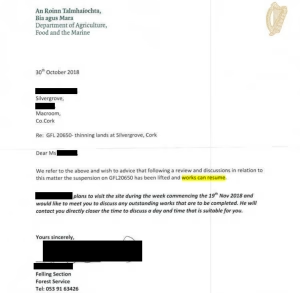
Forest Service Official Works Can Resume Letter Redacted Screenshot
You can download the letter here: Forest Service Works Can Resume Official Letter Redacted
It’s important to note that even at this stage I had heard absolutely nothing from anyone regarding the work we were doing. Despite my sign on the gate, and the notice, anonymous complaints were made, accusations were hurled, but no-one asked for any information or dialogue.
In early November, in an attempt to pre-empt any future issues, we requested a meeting on site with the head of FS Felling Section and anyone else they chose to bring. We wanted the opportunity to openly discuss what we were doing, and to invite any feedback or concerns. FS did not meet us!
January 2019
On Monday the 07/01/19 I received 4 calls from an unknown number, and I also received 2 e-mail enquiries about the work at Silvergrove. I was delighted to finally receive some interest. I answered the calls, answered the e-mails, no problem. The next day I got a call from FS. Apparently there were more complaints.
There were also threads on Linked-in and Twitter with a lot of anger and genuine concerns. There was also a lot of misinformation.
The Facts
- The lands at Silvergrove are not designated as Sensitive, not SAC, NHA, SPA or even pNHA.
- The lands are not in a Fresh Water Pearl Mussel catchment, or within a 6km zone of a FPM catchment.
- The lands are not part of Toon Wood.
- The land is not an ancient oak woodland – it is a farm.
- NPWS, Fisheries, Forest Service and the Department of Agriculture were all consulted and approved the works. (see update below)
- The work was not done in secret, sneaking in over the Christmas holidays, it has been ongoing since early October.
- In Ireland there is a legal process, which was followed, strictly adhered to, or exceeded.
- The work is not yet finished, of course it looks bad now.
- I strongly reject any accusations against the land owner or what she is trying to achieve.
Conclusion
I appreciate everyone’s concerns here. I only regret that I haven’t heard from anyone before now in the 3 years this has been going on. Everyone is entitled to their opinion, and to form their own conclusions, but Foresters (private and public), Dept of Fisheries staff, NPWS staff and Dept of Agriculture staff all approved the work. As environmental professionals we are dedicated to protecting and enhancing our environment, do you really believe this was a conspiracy to destroy an ancient Forest?!?!
All of the above is the truth as it happened, documented in letters, e-mails, texts and pictures. If you’re still dissatisfied then maybe the system let you down. If the system doesn’t work then maybe all that anger should be directed at the system? The land owner did everything by the book. She’s trying something new, something different, and change & the unknown can be frightening. I’m always available to answer your questions, maybe allay some fears, and shed some light. Let’s talk.
Silvergrove – Update and Clarification
The above account was written in good faith in January 2019. However, with the benefit of subsequent events and documentation, it is appropriate to clarify the timeline and Ecoplan Forestry’s role in relation to the Silvergrove site.
Silvergrove Case Study – Licensing and Regulatory Context
The sequence of events can be summarised as follows:
- 2015 – Ecoplan Forestry submitted a Thinning Felling Licence (TFL) application on behalf of the landowner, specifically referencing scrub clearance and scarification by machine as part of the woodland management.
- 2017 – The same TFL application was re-submitted by Ecoplan Forestry and a felling licence was issued again.
- The applications were processed but were not referred to the National Parks and Wildlife Service (NPWS) by the Forest Service despite the site being within a referral zone.
- Forestry works were carried out under the felling licence.
- Following complaints, the Forest Service inspected the site and instructed that works should stop. By this stage, all works north of the public road had been completed.
- The works stopped immediately following this instruction, as directions issued by the Forest Service are official regulatory instructions and must be complied with.
- The Forest Service reviewed the licence and confirmed internally that there was no breach of the licence and that the suspension should be lifted.
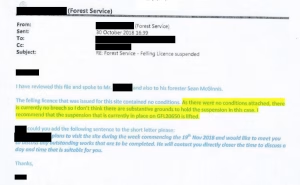
Forest Service No Breach Email Redacted Screenshot
You can download the document here: Forest Service No Breach Email Redacted
- The Forest Service then wrote to the landowner confirming that the suspension had been lifted and that works could “resume”, indicating that the works previously carried out under licence could continue and that outstanding works could be completed. Again, the landowner followed the official instruction.
- 09 January 2019 – The site was visited by two Forest Service Inspectors who discovered a range of issues both north and south of the public road.
- February 2019 – The Forest Service revoked the felling licence. This revocation decision was appealed to the Forestry Appeals Committee.
- March 2019 – The Forest Service issued a Replanting Order for the entire site under Section 26 of the Forestry Act 2014, without any warning or opportunity to make submissions. There is no statutory right of appeal against a Replanting Order, and the only mechanism to challenge such an order is by Judicial Review in the High Court, subject to strict time limits.
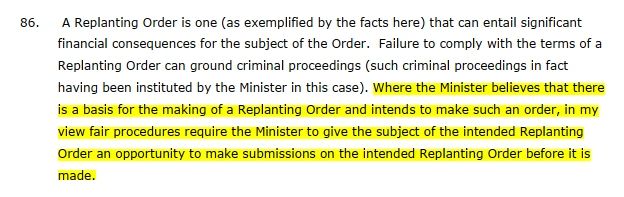
Extract from High Court Judgement 1
-
The landowner had no statutory right of appeal against the Replanting Order and therefore challenged the revocation of the felling licence through the Forestry Appeals Committee (FAC). The FAC accepted that, following inspection and the lifting of the initial suspension, all parties appeared to agree that works to the north of the public road had been completed prior to the reinstatement of the licence. The FAC further noted that the lifting of the suspension gave rise to a reasonable expectation that those works did not warrant revocation. On that basis, the FAC confined its assessment solely to operations undertaken to the south of the public road — being the area where works continued after the licence was reinstated and the landowner had been advised that operations could resume.
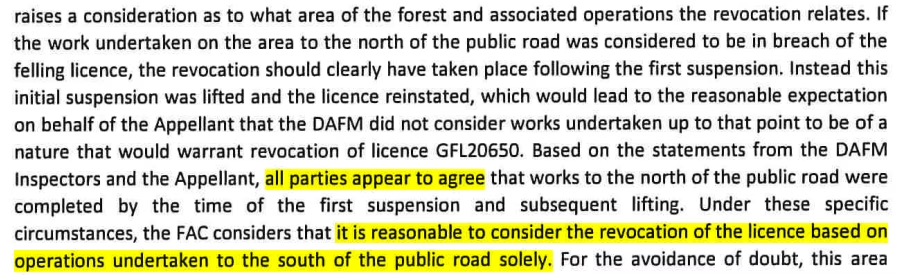
Extract from the FAC’s Silvergrove Decision Letter
- The FAC decision applied solely to operations “south of the public road”, yet upheld the revocation of Licence GFL20650 in full. This is inconsistent with the Forest Service’s earlier position, which identified the northern section as the most heavily cleared, subsequently lifted the suspension, and instructed that works could “resume”, while the FAC accepted that those earlier works did not warrant revocation.
- The landowner then had no other option but to challenge the Replanting Order through the legal system and the matter ultimately proceeded to the High Court.
- November 2021 – The High Court proceedings related primarily to the Replanting Order issued in March 2019 and procedural matters surrounding that order. The High Court did not determine whether the earlier felling operations carried out under licence were lawful or unlawful. As Replanting Orders cannot be appealed, the Replanting Order remains (despite including large areas of sheet-rock and an ESB corridor). The High Court proceedings concluded on procedural grounds and did not involve a determination of the earlier forestry operations carried out under licence, where ‘no breach’ was found by the Forest Service or the FAC, and which was allowed to ‘resume’.
Despite this sequence of events, the Replanting Order for the entire site remains in place, with no statutory right of appeal — notwithstanding that earlier works were accepted as not warranting revocation and were carried out following explicit written instruction to resume. The resulting position is difficult to reconcile with the documented actions of the Forest Service and the conclusions of the FAC, and represents a particularly severe outcome for a landowner who sought to manage their property in accordance with the licence issued and the instructions received.
Key Findings from the Silvergrove Case
- The Forest Service confirmed there was no breach in relation to earlier works
- The suspension was lifted and works were instructed to “resume”
- The FAC accepted that earlier works did not warrant revocation
- The FAC confined its assessment to the south side only
- Despite this, a Replanting Order for the entire site remains, with no right of appeal
Ecoplan Forestry’s Role
Ecoplan Forestry submitted the felling licence applications on behalf of the landowner and acted as forestry agent in relation to licensing and regulatory matters throughout the Silvergrove case.
Ecoplan Forestry represented the landowner in relation to allegations arising from forestry works carried out under licence. This representation was based on the fact that the forestry works had been carried out under a valid felling licence, that works had stopped when instructed by the Forest Service, and that the Forest Service had subsequently confirmed that there had been no breach of the licence and had advised that works could resume. In those circumstances, Ecoplan Forestry considered it reasonable and appropriate to represent the landowner’s position based on the facts as they were known at the time.
As an independent forestry consultant, Ecoplan Forestry’s role is to represent landowners in licensing and regulatory matters, and this sometimes involves representing landowners in disputes or regulatory matters. In the Silvergrove case, Ecoplan Forestry considered it important to represent the landowner’s position based on the documented facts, even though involvement in a high-profile dispute with regulators was likely to have professional and reputational consequences. Ecoplan Forestry’s position throughout was based on documented Forest Service findings and instructions, and its role was to represent the landowner in accordance with those records.
Ecoplan Forestry was not involved in any harvesting operations at the site and was not involved in the legal proceedings that later followed, as the case was focused on procedure rather than silvaculture.
Ecoplan’s Role: A Fact-Based Summary
- Design, Not Execution: Ecoplan’s involvement was strictly as a technical and administrative consultant. The firm authored the felling applications and the management plan, which were based on the principles of thinning and natural regeneration. Ecoplan had no role in the physical harvesting or land-clearing operations at Silvergrove – As an independent forestry consultant, Ecoplan Forestry does not carry out harvesting operations and acts solely in the interests of the landowner in licensing and regulatory matters.
- Regulatory Validation: In October 2018, following a detailed review and site investigation, the Head of the Forest Service Felling Section officially concluded that there was “no breach” of the license. This was an expert-level confirmation that Ecoplan’s advice and the project’s progression were compliant with the license as issued.
- The “Resume” Directive: The Head of the Felling Section issued a formal, written instruction for the landowner to “resume” works. The landowner acted in good faith based on this direct guidance from the highest level of the relevant state authority. This position is reflected in the High Court judgment, which records that the Forest Service confirmed that there was “no breach” of the licence and that the suspension had been lifted and works could “resume”.
- The Regulatory U-Turn: The controversy arose only when the Department subsequently reversed its earlier findings. The subsequent “negative association” stems from this state inconsistency, where the Forest Service later took enforcement action against the landowner for actions the Service had previously confirmed no breach and advised ‘resume’.
- Uncontested Assertions: While the High Court later upheld the state’s right to issue a Replanting Order, the court case was decided on procedural technicalities (such as the 3-month filing limit) and did not involve a factual trial. The Department’s later claims of “excessive felling” were not determined in a full factual hearing; they remained as “opinions” that were legally final only because the statute provides no mechanism for a merits-based appeal.
A Commitment to Regulatory Accountability and Landowner Rights
At Ecoplan Forestry, we believe that a fair and functional forestry sector depends on regulatory certainty and the right of every landowner to rely on the official word of the State. Our involvement in the Silvergrove project was defined by a principled defense of these core values. When the Department of Agriculture’s own Head of the Felling Section officially reviewed our work, confirmed in writing that there was “no breach,” and formally instructed the landowner to “resume” operations, a clear legal and professional benchmark was set.
Ecoplan stood firmly by the landowner when the Department subsequently attempted a retrospective “U-turn” on its own expert validation. We maintained our advocacy even as the State used procedural technicalities—such as the lack of a merits-based appeal for Replanting Orders—to shield its own internal inconsistencies from factual cross-examination. For Ecoplan, defending Silvergrove was never about avoiding a “negative association”; it was an act of professional integrity. We chose to protect our client’s rights against an unpredictable regulator, proving that we will not stay silent when a private citizen is penalized for following the government’s own explicit, written directions.
A Catalyst for National Reform
Here is a summary of the landmark changes triggered by the legal and administrative deadlock seen in the Silvergrove case:
- Exposing the “Statutory Hole”: The Costello v Minister for Agriculture [2021] IEHC 735 case proved that Replanting Orders were uniquely “unappealable” under the existing law. Mr. Justice Ferriter explicitly noted that “fair procedures generally require” a right to be heard before such a heavy order is issued, a principle the State has had to reconcile with ever since.
- The Forestry (Miscellaneous Provisions) Act 2020: The procedural confusion and the massive backlog of appeals exposed by high-profile cases like Silvergrove directly contributed to the drafting of the 2020 Act. This legislation aimed to speed up the appeals process by enabling the Forestry Appeals Committee (FAC) to sit in multiple divisions.
- Mandatory “Felling and Reforestation Standards”: In October 2019, the Department introduced new mandatory standards that immediately replaced guidelines from 2000. These new rules were designed to eliminate the “ambiguity” of the unconditional licenses that led to your dispute.
- Professionalization of Oversight: The Forest Service acknowledged its errors and began recruiting additional ecologists and inspectors to ensure that all applications are scrutinized to the highest environmental standards before a decision is made, avoiding the internal confusion seen in 2018.
Note: This page was originally written in 2019 and has been substantially updated in March 2026 to reflect subsequent developments and documentation.
Sean McGinnis
Ecoplan Forestry Limited
18 Cluain Rhaine,
Banagher, Co. Offaly.
R42 P282
087 9302922
sean@ecoplan.ie