

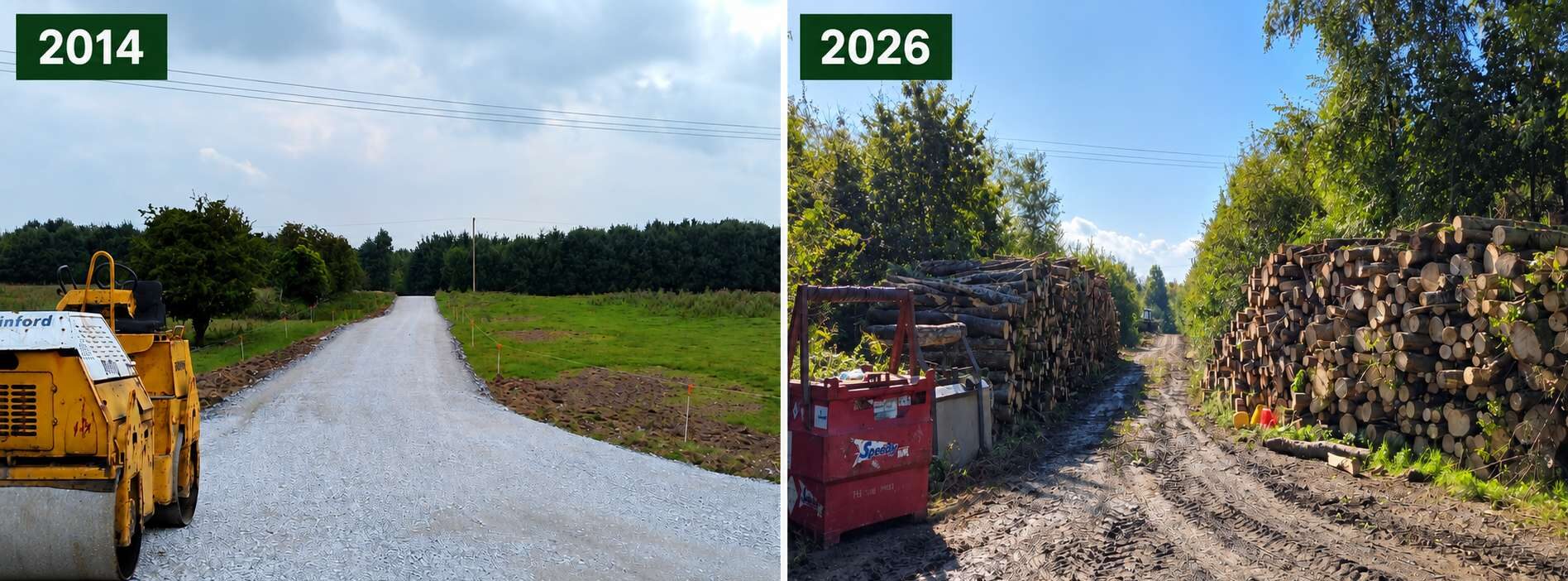
27 Sep The Importance of Stewardship Continuity in Forestry
Forestry is usually discussed in terms of plans, grants, planting specifications, inspections, thinning schedules and timber prices. All of those things matter. But woodland is not managed as a series of isolated tasks. It develops over decades, and the quality of its management depends heavily on whether the person guiding it retains a real understanding of what has gone before.
That is the idea behind Stewardship Continuity.
What is Stewardship Continuity?
Data is not presence. Records can preserve information, but they cannot reproduce the experiential human memory built through repeated involvement with a place and its people. Good records and useful technology strengthen Stewardship Continuity; they do not replace the personal experience and judgement that give those records their fullest meaning.
It is an aspiration rather than a promise. No forester, owner or company can guarantee that they will remain involved forever. But it is a useful standard by which to judge long-term forestry: how much of the understanding built around a woodland remains with the person making the next decision?
Forestry is a long conversation
Most forests outlast the people who establish them. A decision made at planting may shape the woodland for forty, sixty or a hundred years. The same is true of the smaller decisions made along the way: where a fence was placed, how a wet corner was handled, which access route was used, why a particular contractor was chosen, or why an owner decided that biodiversity, timber, legacy or family use mattered most.
These matters do not always appear fully in an application file or a management plan. A good record may show what was done. It cannot express what was learned while doing it.
A forester who has walked the ground in difficult weather, watched a crop establish, dealt with an unexpected drainage issue, discussed a plan repeatedly with an owner, or worked through a difficult operation with a contractor develops a kind of understanding that is both practical and personal. It informs the next decision in ways that a new person, however capable, cannot immediately reproduce and could never fully understand.
Records are essential, but they are not the whole story
Professional forestry needs good records. Maps, soil tests, approvals, photographs, contracts, invoices, inventories and management plans should be retained and kept in order. They allow work to be checked, explained and handed over.
But a file is not the same as familiarity.
It may record that a contractor planted a difficult site. It cannot fully convey how that contractor trudged over the ground, where machinery struggled, what proved workable, or which small adjustments made the difference. It may show that a decision was made to delay an operation, or threats were implied to get it done—perhaps no more than the suggestion that a working relationship would be soured if it did not proceed. It may not carry the conversations, risks and observations that led to that judgement. A spreadsheet can record that a thinning took place and provide a certain income; it cannot record the owner’s relief that that income arrived just in time to pay for their daughter’s wedding.
The same is true of the owner relationship. A woodland plan may list objectives, but it rarely captures the gradual understanding that comes from meeting an owner over time: what they are worried about, what they value, what they are willing to do, and how their hopes for the place may be changing. Planting land in Ireland is often emotional, the landowners can remember bailing hay in a field with their grandfather when they were young, or burying the family pet in another; those memories are important, and they cannot be squeezed into a box in a spreadsheet. They need to be understood. They matter.
That accumulated understanding is not an argument against good documentation. It is the reason good documentation should be combined with continuing, personal involvement.
Stewardship Continuity is not confined to work carried out in the forest. It should run through the whole responsibility for a woodland: the first site visit and conversations with the owner; the research, mapping and applications; the contracts and discussions with contractors; and the checking and approval of invoices when the work is complete. These are not separate administrative tasks. They are part of how decisions are made, how relationships are built, and how a forester comes to understand what has been agreed, what was difficult, and what should happen next.
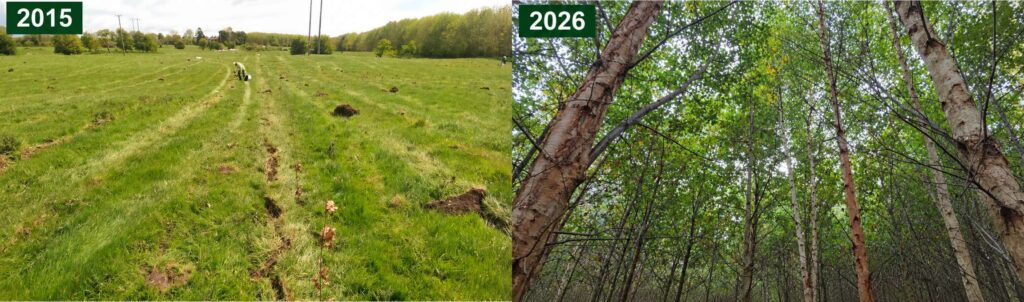
Stewardship Continuity is a spectrum
Stewardship Continuity is when one individual remains personally involved in, and responsible for bringing together, every aspect of a forest’s management over time — from site knowledge and owner advice to applications, mapping, contractors, costs and future decisions.
Stewardship Continuity is an aspiration, not a purity test. It can be strengthened or weakened over time; it does not disappear simply because a forester needs practical help.
A short illness, specialist assistance, or administrative support does not break continuity where the responsible forester remains involved and returns to the work. A map may be formatted by someone else, for example, without losing its continuity if it remains based on that forester’s original site knowledge and instructions.
The real loss occurs when responsibility is divided or passed on in a way that separates decisions from the person who understands the site, its history, its owner and the reasons behind earlier choices. Forestry is practical work, and Stewardship Continuity should be practical too.
The risk of corporate amnesia
Large organisations can hold extensive records for a forest while still losing much of its living history. Where responsibility repeatedly moves between people, information may survive but the direct experience behind it becomes fragmented.
This can be called corporate amnesia: not a failure to keep files, but a gradual loss of the unwritten knowledge created by actually looking after a place. High Yield Classes or good stem quality at year 20 say nothing about the targeted formative-shaping or the heavy grass-cleaning during establishment that led to them.
It is not confined to forestry, and it is not inevitable in every large organisation. It can arise anywhere a long-term asset is managed through short-term assignments, changing personnel or disconnected contracts. In forestry, however, the consequences can be especially significant because the timeframes are so long, the land itself is so variable, and the memories are so real.
The owner often feels the effect first and carries this cost. They are the ones left standing at the forest gate, repeatedly explaining the same unusual features of their woodland to a succession of new advisers: the hollow that holds the frost, the track that only stands up to machinery in dry Augusts, or the reasoning behind a past planting boundary. The new forester may be conscientious and professional, but the process begins again.
Stewardship Continuity does not claim that change can always be avoided. It asks that change is recognised as a real cost, rather than treated as irrelevant because the paperwork remains.
Why continuity improves decisions
Continuity does not mean doing the same thing forever. Good forestry adapts: crops change, markets move, grants change, storms occur, owners’ circumstances develop, and owners often change. The value of continuity is that change is considered with a deeper understanding of its consequences.
A forester who knows a woodland over time can connect decisions that might otherwise be treated separately. They may recognise that a minor road decision affects a future thinning operation; that an establishment problem explains later variation in a crop; or that a seemingly modest ecological feature has become central to the owner’s aspirations for the land. Stewardship Continuity explains why that twisted horse-chestnut that’s supressing the oak all around it hasn’t been removed – because that chestnut was planted by the owner’s late husband and daughter many years ago.
Continuity also helps build better working relationships. Contractors are more effective when their practical knowledge of a site is respected and remembered. Owners make clearer choices when they work with someone who understands both the physical woodland and the reasoning behind past decisions. And difficult years are easier to work through when trust has been earned before the difficulty arrives.
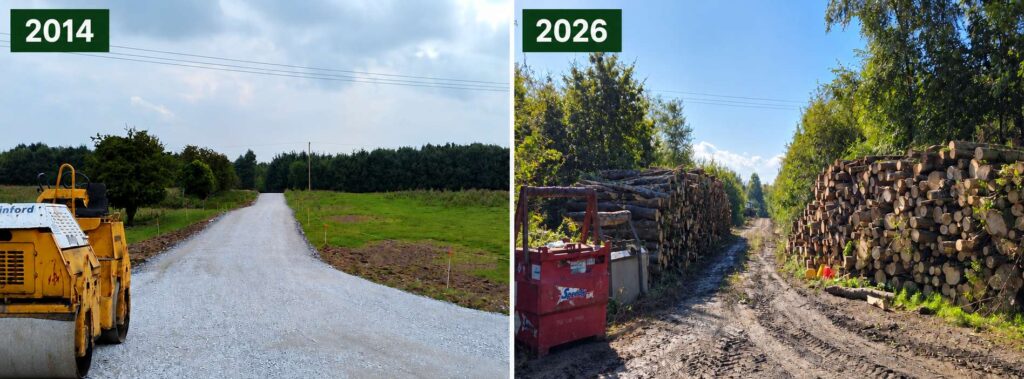
Stewardship can begin at any stage
Ideally, Stewardship Continuity begins at the first site visit and continues through establishment, maintenance, thinning, harvesting and renewal. That gives the fullest opportunity for knowledge to accumulate naturally.
But it is never too late for a more continuous form of stewardship to begin. An owner changing adviser can still choose someone who takes the time to understand what has happened before, rather than treating the woodland as a blank new file. That may involve reading the available records, but it also means walking the site carefully, speaking to those who have worked there, and listening properly to the owner.
The aim is not to pretend that lost experience can be recovered in a day. It is to stop the loss from continuing and begin building the understanding that future management deserves.
Continuity should never limit choice
Stewardship Continuity has value, but it should never be used to hold an owner hostage to unnecessarily high fees, poor service or a lack of competition. A woodland owner must always remain free to change adviser, seek another opinion, or take a different direction for their land.
Forests can be, and often are, well managed with little Stewardship Continuity. Good records, capable new advisers and sensible decisions can still achieve excellent results. Continuity is not essential in every case, nor does it give any forester an entitlement to a client’s work. It is simply a valuable advantage when it exists: a depth of understanding that can help future decisions, provided it is earned through good service and remains worthwhile to the owner.
A useful question for woodland owners
When choosing forestry advice, it is sensible to ask about qualifications, experience, services and price. It is also worth asking a quieter question:
Who will still understand this woodland when the next important decision has to be made?
The answer will not always be one person forever. But the more directly a forester remains involved in a woodland’s life, the more likely that its future management will benefit from the knowledge, relationships and judgement already earned on the ground.
That is the importance of Stewardship Continuity. It recognises that a woodland is not merely an asset to be processed or a set of records to be maintained. It is a living place with a history — and the best future decisions are made by people who know that history because they helped to create it.
This article was written by Sean McGinnis, founder of Ecoplan Forestry. At Ecoplan, we provide independent, specialist, and ecological advice guided by our long-term aspiration toward Stewardship Continuity across the Irish woodlands we care for.
Sean McGinnis Ecoplan Forestry