
25 Oct The Gods of Ireland’s Ancient Woodlands
The Gods of Ireland’s Ancient Woodlands
For thousands of years, Ireland’s forests were more than simply places where trees grew.
They provided timber, fuel, food and shelter, but they also occupied another place in the Irish imagination. Woodlands marked boundaries between the familiar and the unknown. Great trees could be sacred. Wells, rivers and particular places had supernatural associations. Animals could cross the boundary between this world and another.
And within this landscape lived the gods.
Or did they?
The idea of ancient Ireland populated by clearly defined “gods of the forest” is an attractive one, but the surviving Irish traditions are much more complicated. Unlike the gods of Greece or Rome, Ireland’s supernatural figures don’t fit neatly into categories. There was no simple Irish equivalent of a single god who ruled over every tree and woodland.
Instead, the surviving stories give us figures associated with wild animals, hunting, fertility, particular trees and landscapes, alongside supernatural beings whose worlds seem inseparable from the natural environment.
To understand the gods of Ireland’s ancient woodlands, we can’t look for a single forest god, but at the much older relationship between people, trees, animals, landscape and the Otherworld.
Flidais – Lady of the Wild
Perhaps the most obvious place to begin is with Flidais.
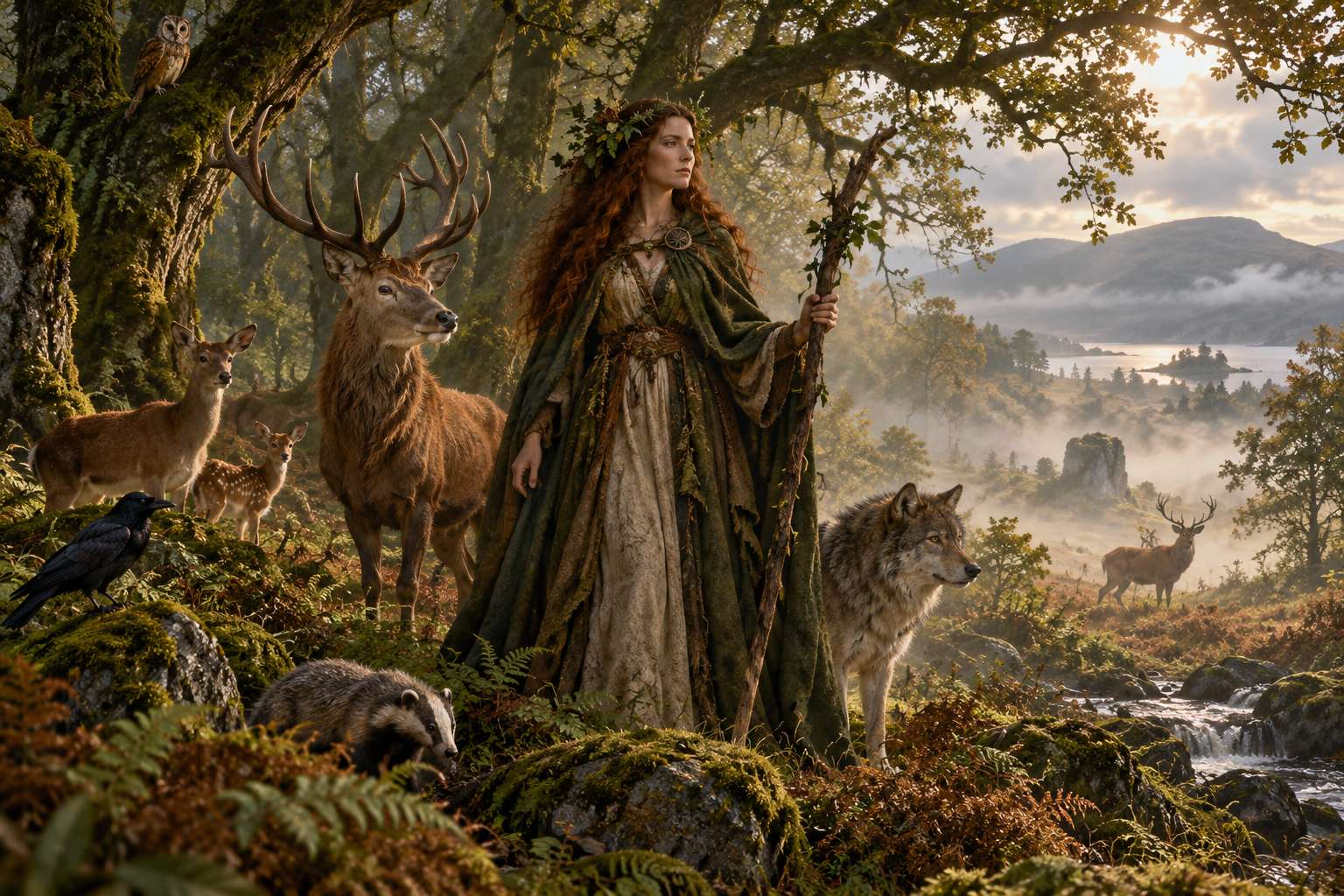
In medieval Irish literature, Flidais is associated particularly with wild animals and cattle. Later interpretations have sometimes described her basically as a “woodland goddess” or “goddess of the hunt”, although the surviving sources do not give us such a convenient job description.
What they do give us is a supernatural woman intimately connected with animals and the uncultivated landscape.
That distinction matters.
To people living in a heavily wooded Ireland, the forest was not simply scenery. It was the habitat of deer, wolves, and wild boar, a source of food and materials, a place of danger and an environment lying partly beyond the controlled agricultural landscape.
A figure associated with the animals of that world would therefore have represented something much larger than our modern idea of a woodland deity.
Flidais belonged to the wild.
And in ancient Ireland, much of that wildness was woodland.
The Dagda – Abundance, Fertility and the Land
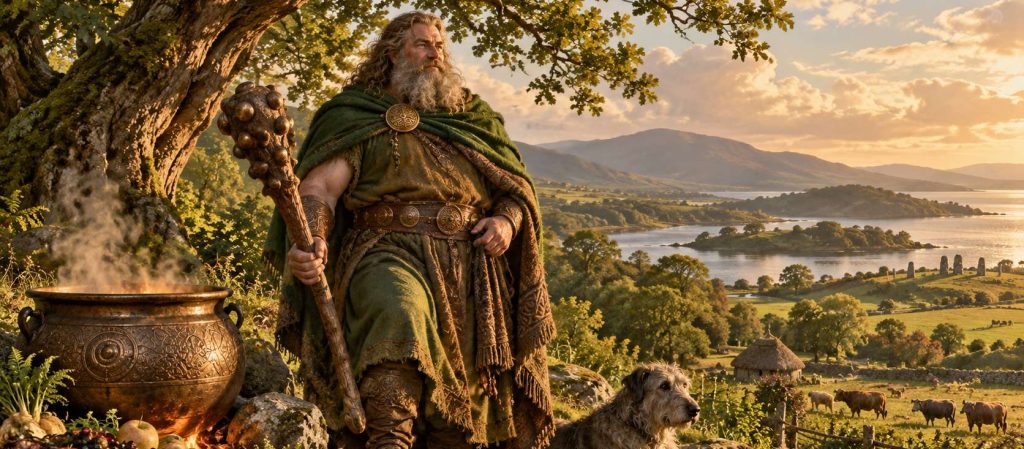
The Dagda is one of the great figures of Irish mythology and a member of the Tuatha Dé Danann.
He is associated with abundance, fertility, knowledge and supernatural power. Among his famous possessions is a cauldron said never to leave anyone unsatisfied, while his enormous club could kill with one end and restore life with the other.
He is not, strictly speaking, a god of forests.
But perhaps that is imposing a modern distinction on an older worldview.
For an agricultural society surrounded by woodland, fertility did not stop at the edge of a field. The productivity of the land included grazing, crops, animals, water and the resources obtained from woods.
The Dagda represents abundance in a world in which human prosperity and the fertility of the natural landscape were intimately connected.
So, his stories belong naturally within any exploration of how the supernatural and the wooded landscape overlapped in early Irish tradition.
Cernunnos – Was the Famous Horned God Irish?
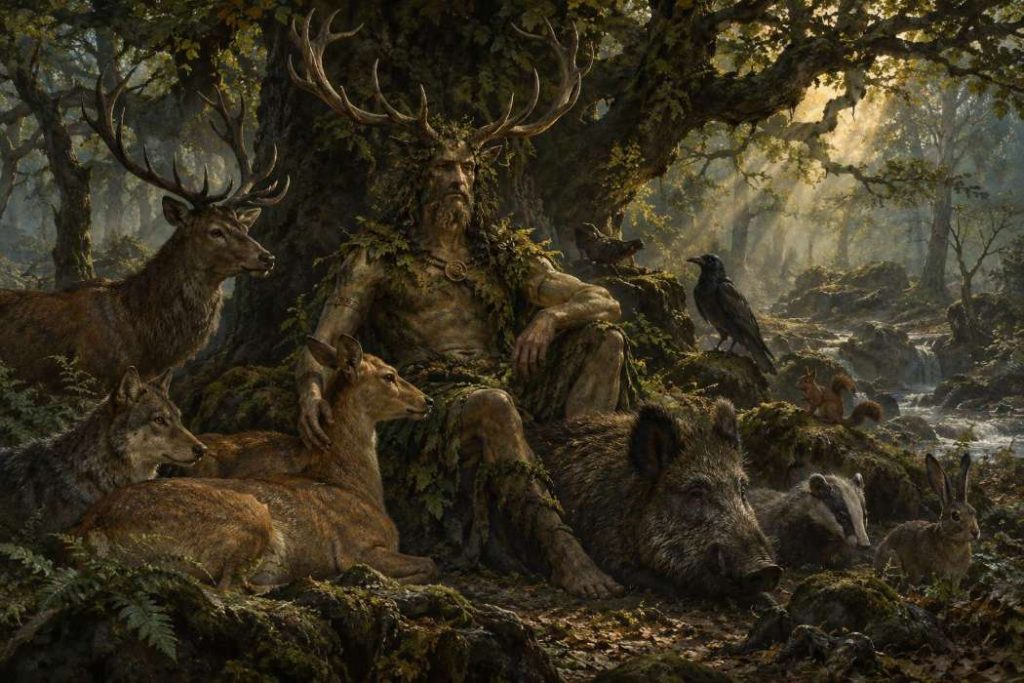
Few images seem to represent the idea of an ancient woodland god better than Cernunnos.
He is commonly portrayed as a horned or antlered deity, surrounded by animals, and today is frequently described as a Celtic god of forests, wildlife and nature.
There is only one problem.
We cannot confidently call Cernunnos an Irish god.
Evidence for Cernunnos comes primarily from continental Europe and the Roman-period Celtic world. His name and imagery have become incorporated into a much broader modern idea of “Celtic mythology”, within which traditions from Ireland, Britain, Gaul and elsewhere are sometimes mixed together.
That makes him fascinating, but it also requires caution.
Ancient Celtic-speaking peoples undoubtedly shared cultural connections, but “Celtic” did not mean that every community from Ireland to central Europe worshipped an identical pantheon.
Cernunnos may tell us something important about supernatural relationships with animals and the wild in the wider Celtic world.
But putting him directly into an ancient Irish forest would go beyond the surviving evidence.
And that distinction between what we know and what we would like to imagine is important when trying to understand Ireland’s ancient woodlands.
The Sacred Tree
Perhaps the closest thing Ireland had to a woodland deity was not a human-shaped god at all.
It was the tree itself.
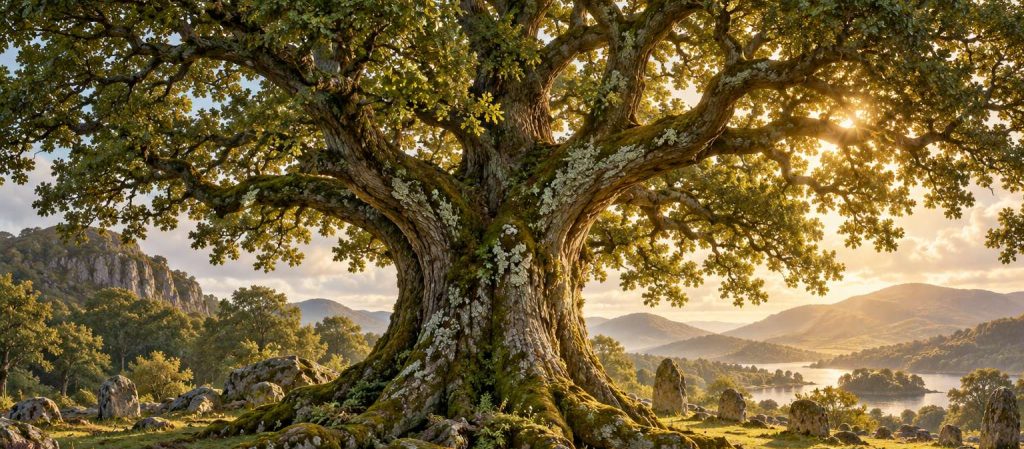
Trees occupy an extraordinary position in Irish tradition. Certain individual trees were associated with kingship, territories, inauguration sites and sacred places. Some were sufficiently important for their destruction to be remembered in literature.
The great bile, or sacred tree, could represent far more than timber or even biological life. It could become a symbol of a community and its relationship with the land.
That makes the modern distinction between worshipping a god associated with a tree and regarding the tree itself as sacred much less useful.
Oak, hazel, yew, rowan and other species acquired layers of cultural significance.
And some of those associations have survived remarkably well.
Trees as Gateways to the Otherworld
Ireland’s mythology repeatedly blurs the boundary between the ordinary landscape and the Otherworld.
A hill might conceal an entrance to another realm. A well could possess supernatural properties. An apparently ordinary animal might be anything but ordinary.
Woodlands were particularly suited to such stories.
Anyone who has walked from an open field into an old Irish woodland will understand why.
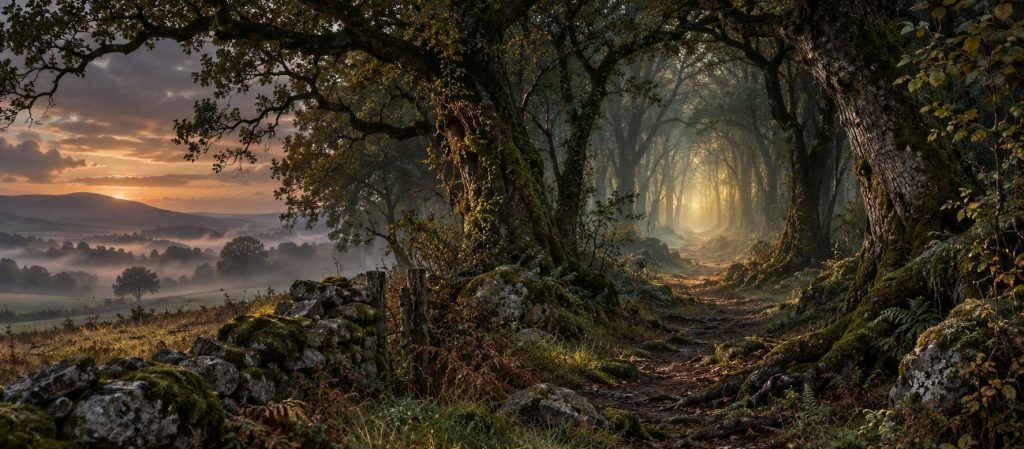
The light changes. Visibility contracts. Sounds become harder to locate. Paths disappear. A landscape that could be understood from a distance suddenly surrounds you.
For our ancestors, entering a forest meant entering a place where human control diminished.
It is perhaps unsurprising that trees and woodland became associated with places where the familiar world met something older and stranger.
I’ve spent much of the past 30 years working in Irish forests, and even now, with all the modern knowledge available to us, I can understand how ancient beliefs took hold. Some forests feel magical. Others feel threatening, depressing or simply sad, and there is no obvious connection between how a forest looks and how it feels. Some are disorientating in a different way: it is easy to lose your bearings, or even to lose track of time.
It is easy to scoff at ancient beliefs. But at times, it is just as easy to understand them.
Gods, Spirits – or Something Else?
There is a temptation when looking at ancient Irish mythology to organise everything neatly.
This figure was the god of this.
That figure was the goddess of that.
But Irish mythology, like the Irish themselves, stubbornly refuses to cooperate.
The beings later written about as the Tuatha Dé Danann were preserved through manuscripts created in a Christian Ireland, often centuries after the traditions themselves had begun. The people recording the stories were interpreting an older belief system through a very different worldview.
What survives is therefore patchy and incomplete.
A supernatural figure associated with deer may once have been a deity, a local cult figure, an ancestral being, a literary character — or several of these things at different times.
We simply cannot always know.
And perhaps that uncertainty is part of what makes Ireland’s woodland mythology so compelling.
The Forest Never Entirely Disappeared
Ireland today is very different from the landscape in which these stories developed.
Much of the great woodland cover disappeared. Sacred groves ceased to function as they once had. Christianity transformed religious belief, agriculture transformed the landscape, and eventually commercial forestry introduced entirely new kinds of forests.
Yet something survived.
The reluctance to interfere with a lone hawthorn associated with the fairies is probably the most famous example. Stories surrounding ancient trees, holy wells, ringforts and particular places continue to influence behaviour even in modern Ireland.
The gods of the ancient woodlands may have faded from memory.
The sense that certain trees and places deserve respect did not.
Perhaps that is their most remarkable legacy.
Thousands of years after those beliefs first developed, we can still walk into an old Irish woodland and recognise something of what our ancestors must have felt.
Forests are a collection of trees.
But they have never been only a collection of trees.
And they are so much more to me.
About the Author: Sean McGinnis is an independent forester who established Ecoplan Forestry to provide a different perspective for forest owners in Ireland, offering site and owner-specific forest stewardship continuity instead of short-term rotating management-by-numbers.